
Professional services / Worked-to-cash
Professional services is moving beyond the billable hour. The operating model has to catch up.
AI is weakening the link between effort and value. Measuring the full path from work performed to cash helps firms improve hourly economics now and price fixed-fee or outcome-based work with evidence.
In a professional-services firm, work can be complete while the invoice is still days or weeks away. Time remains in draft assembly, project-manager review, worked-versus-billed revision, approval, and period-end batching.
One recurring pattern comes from bespoke, high-touch time-and-materials projects, frequently delivered for private-equity firms or PE-backed companies. Senior judgment is integral, the work is client-specific, and scope or staffing can evolve during delivery. On this page, “bespoke / high-touch T&M” is descriptive shorthand for that context, not a recognized industry category.
That operating context creates a worked-to-billed review: the team must reconcile work performed with scope, staffing, client expectations, and what is commercially appropriate to invoice. The resulting review and revision tail delays invoice issue; because accounts receivable cannot begin before an invoice exists, the same delay extends worked-to-cash.
Other structures produce different shapes. Standard T&M may form a compact post-close band, fixed-fee work may arrive in milestone-driven islands, and retainers may follow a scheduled stripe near period end. A single average invoice date collapses those operating systems into one number.
Why now / Pricing and delivery
Efficiency is breaking the link between hours and value
The billable hour works best when effort is a reasonable proxy for value. AI weakens that relationship: when a firm produces the same or better result with fewer hours, hourly economics can turn efficiency into revenue pressure.
Fixed-fee and outcome-based pricing can align price more closely with client value, but they also move more estimating, scope, delivery, margin, and acceptance risk onto the firm. Moving away from hours without operating evidence is not pricing innovation. It is an unmeasured transfer of risk.
Hourly / Improve now
Tighten the conversion of work into cash
Make worked-versus-billed revisions, review burden, approval lag, unbilled WIP, invoice errors, and collection friction visible, then remove the avoidable delay.
Fixed fee or outcome / Prepare next
Make delivery economics measurable
Establish actual cost-to-serve, scope and exception behavior, milestone and acceptance triggers, realized margin, and evidence that the promised client outcome occurred.
Work performed → commercial decision → invoice or acceptance → cash → realized margin and client outcome
Market context: organization-wide GenAI use reached 40% while only 18% reported tracking ROI in the 2026 Thomson Reuters AI in Professional Services Report. In legal services, the most visible current example, BigHand’s 2026 finance report reports increased demand for alternative and value-based pricing alongside pressure to reflect AI efficiency in commercial models.
Figure 1 / Comparative timing
Four billing models, one period-end axis
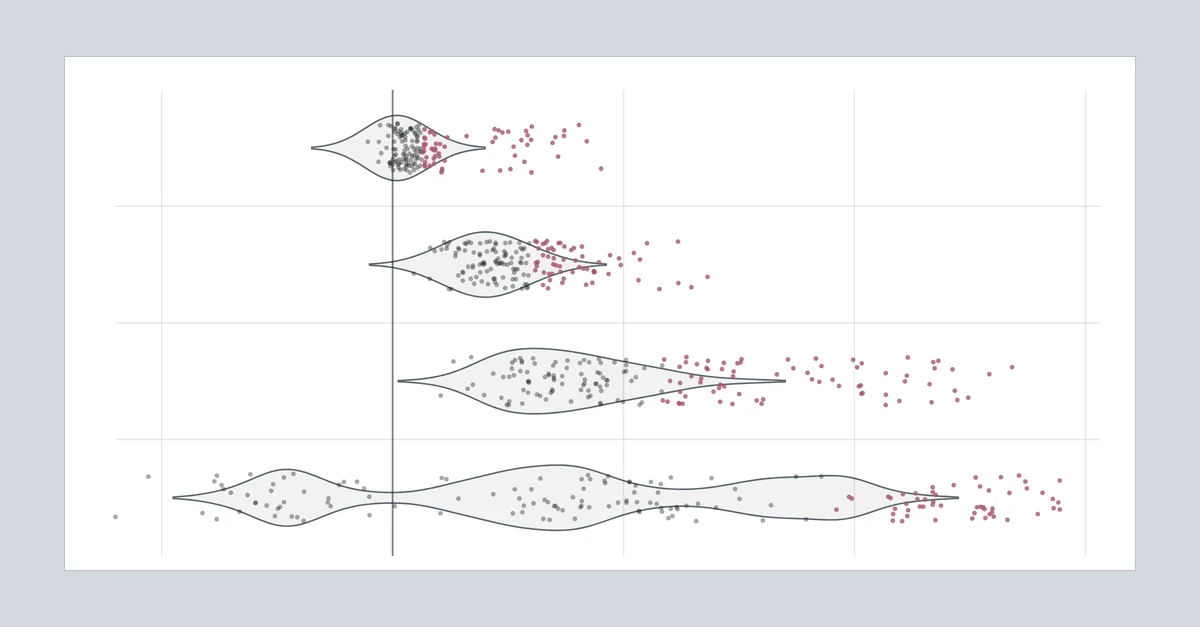
Each dot is one synthetic invoice-month. Scroll through six modeled closes to see what responds and what remains structural. Rows run from the most temporally predictable billing pattern to the least.
Modeled close progression
Scroll to advance the current state. Expected shapes stay fixed; faint rings retain the baseline.
Four synthetic billing distributions on a shared business-day axis. As the reader advances through six modeled close states, current events move toward fixed expected envelopes while faint outlined points retain their baseline positions. Each row's median invoice-issue day and P10-to-P90 timing spread appear at the right.
Baseline. Retainer or recurring median 1.0 day and spread 5.3 days. Standard T&M median 5.3 days and spread 5.8 days. Bespoke or high-touch T&M median 10.1 days and spread 16.1 days. Fixed fee or milestone median 10.6 days and spread 31.1 days.
Late timing is not evenly distributed. Standard T&M mostly clusters just after period end, while senior commercial review on bespoke projects and milestone approval create long tails; recurring work is compact but still carries a small exception set.
The modeled close pulls routine events earlier and reduces late exceptions, but it does not make the four distributions identical. Clearer policy and earlier inputs can tighten the standard and bespoke, high-touch T&M patterns, while milestone and recurring arrangements retain much of their underlying cadence.
The faint baseline imprint separates change from structure. It shows where timing responds to process discipline and where the commercial model remains the dominant explanation.
Figure 2 / Stage decomposition
Where worked-to-billed review widens the tail
The bespoke, high-touch T&M pattern described above, decomposed from final billable work through cash. Expected ranges are locally defined; berry marks only later-than-expected events.
Synthetic bespoke, high-touch time-and-materials events remain compact through draft assembly, spread at project-manager review and revision, and carry that timing tail through cash.
Viewed stage by stage, the distribution remains relatively compact through final work and draft assembly, then widens during project-manager review and worked-versus-billed revision. Once that delay enters the process, invoice and cash events carry it forward.
That diagnosis is the beginning of the work, not its conclusion. Faster billing close and lower error rates matter because they change when an accurate invoice reaches the client, how often it is disputed, and how reliably the resulting cash can be forecast.
Operating sequence / From evidence to outcome
What happens and what it enables
The work follows five moves. Each one has an operating job and an enabled state; none is treated as the business result by itself.
-
01
Observe
Reconstruct the operating truth
System history establishes when work ended, invoices were created or changed, who touched them, and when cash arrived. Targeted interviews recover the judgment and handoffs the record cannot show.
Enables A defensible baseline by billing model, client, project, and owner.
-
02
Diagnose
Separate structure from leakage
Expected-versus-observed timing distinguishes commercial cadence from avoidable review, revision, approval, and batching delay.
Enables A ranked set of mechanisms to change, not a generic automation backlog.
-
03
Build
Install the operating system
Billing rules, input cutoffs, exception lanes, approval windows, ownership, and a recurring management view turn the diagnosis into a repeatable close.
Enables An earlier, more reliable billing close with fewer manual errors.
-
04
Intervene
Move the cash drivers
Automated draft preparation, PM review packages, dispute routing, and collection follow-up target the few controls that actually shape timing.
Enables Less unbilled WIP, cleaner invoices, fewer disputes, and earlier collections.
-
05
Measure
Prove the effect
Recreate the timing shapes each cycle and track work-to-invoice days, invoice-to-cash days, total worked-to-cash, first-pass accuracy, disputes, forecast error, realized margin, and client outcome evidence.
Enables Evidence of where worked-to-cash tightened, whether the economics held, and how to price the next engagement.
Factory floor / One concrete implementation
What actually gets built
The work is not a diagnostic report passed over the wall. Evidence is converted into new decisions, redesigned operating routines, working automation, and a management cadence that measures whether cash performance really changes.
Reconstruct how work becomes cash
Join system history with targeted interviews to locate the judgment, rework, and handoffs that timestamps alone cannot explain.
- Inputs Time and expense, project and staffing data, scope changes, invoice edits and credits, A/R, collections, bank activity.
- Installed output An event-level work-to-bill-to-cash model segmented by billing type, client, project, and owner.
Rework people, process, and technology together
The ranked delay mechanisms become a future-state operating design, not a generic automation backlog.
- People Decision rights, named owners, review roles, escalation paths, and management cadence.
- Process Input cutoffs, approval windows, exception lanes, billing rules, and collection handoffs.
- Technology Source connections, workflow triggers, controlled overrides, audit trails, and automation requirements.
Install the cash and performance tools
Tools are built around the redesigned decisions and controls, rather than layered over the old process.
- Automated 13-week cash flow A source-fed weekly forecast with controlled management overrides, receipts and disbursements, scenarios, minimum-liquidity visibility, and backtesting.
- Billing and working-capital tools Close queues and performance views for unbilled WIP, median and spread, work-to-invoice, invoice-to-cash, first-pass accuracy, disputes, and forecast error.
Turn the tools into a management system
Finance and operating owners use the same evidence to act on exceptions, make cash decisions, and improve the system each cycle.
- Weekly cadence Billing-close review, 13-week cash review, scenario decisions, exception ownership, and escalation.
- Feedback loop Actual versus forecast, timing-shape recreation, realized margin, client outcomes, and intervention performance.
Operating logic
The primary clock is worked-to-cash, not DSO
Direction of influence, not measured client results.
Earlier inputs. Bounded PM review. Routed exceptions.
Earlier invoice issue. Higher first-pass accuracy. Fewer credits and re-bills.
Less unbilled WIP. Fewer disputes. Earlier, more predictable collections.
Shorter worked-to-cash. Less liquidity stranded before invoicing. More reliable 13-week liquidity visibility. Measured delivery economics for fixed-fee and outcome pricing.
DSO starts at invoice issue, so it cannot see the worked-versus-billed review and approval lag that often dominates professional-services cash conversion. The primary measure is therefore total worked-to-cash, decomposed into work-to-invoice and invoice-to-cash. A cleaner process may still improve DSO at the margin by reducing disputes and collection friction, but DSO is not the complete operating clock.
The practical entry point is one billing cycle: enough evidence to reconstruct the timing, identify the mechanisms, and determine which operating changes and tools are worth building.
For firms where invoices routinely slip past period end, PM revisions are heavy, or cash forecasts keep absorbing unexplained timing noise, the practical next step is to test the method against one billing cycle. Bring this question